Aircraft N715NA Data
1
aircraft record found
N715NA
1965 De Havilland Canada C-8A (CV-7A) Buffalo, c/n 2
Latest photos of N715NA
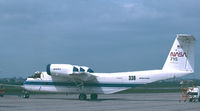
Fred Willemsen
@ LFPB
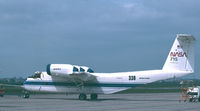
Fred Willemsen
@ LFPB

Van Propeller
@ LFPB
Airframe Info
| Manufacturer | De Havilland Canada |
| Model | C-8A (CV-7A) Buffalo Search all De Havilland Canada C-8A (CV-7A) Buffalo |
| Year built | 1965 |
| Construction Number (C/N) | 2 |
| Aircraft Type | Fixed wing multi engine |
| Number of Seats | 44 |
| Number of Engines | 2 |
| Also Registered As |
63-13687
Transferred to NASA
|
Aircraft
| Registration Number | N715NA |
| Mode S (ICAO24) Code | A98FCD |
| Certification Issued | 1974-09-03 |
| Last Action Taken | 1994-02-16 |
| Current Status | Deregistered |
| Registration Cancel Date | 1996-09-24 |
Owner
| Registration Type | Government |
| Owner | NATIONAL AERONAUTICS AND SPACE ADM |
| Address |
Moffett Field, CA 94035 United States |
User contributed data
| Serial Number (c/n) | 2 (by Henk van Capelle on 2016-06-03 20:40:40) |
User Comments
Malcolm Clarke, 2016-06-03 21:24:58
Delivered as CV-7A to US Army May 1965. Transfered to USAF Jul 1966 as C-8A, assigned to Air Force Systems Command for testing. To Univ of Michigan as N326D operating for National Center for Atmospheric Research. Assigned to NASA Ames Research Center, NAS Moffett Field, CA Aug 3, 1978 to Nov 22, 1993. Used for boundary layer control, STOL and V/STOL research.
Modified as a Quiet Short-Haul Research Aircraft [QSRA]. Modified by Boeing the QSRA featured four jet engines whose exhaust was directed over the upper surface of the wing and curved flaps. Through the Coanda effect, a portion of the propulsive force was deflected into propulsive lift while lift was further augmented by increased circulation associated with the high-velocity exhaust air flowing over the wing. The QSRA demonstrated its STOL performance by operating aboard the aircraft carrier USS Kitty Hawk without a need for catapult launch or landing arresting gear. Registered as NASA 715. Registered as N715NA Sep 3, 1974, cancelled Sep 24, 1996. (Joe Baugher)
Modified as a Quiet Short-Haul Research Aircraft [QSRA]. Modified by Boeing the QSRA featured four jet engines whose exhaust was directed over the upper surface of the wing and curved flaps. Through the Coanda effect, a portion of the propulsive force was deflected into propulsive lift while lift was further augmented by increased circulation associated with the high-velocity exhaust air flowing over the wing. The QSRA demonstrated its STOL performance by operating aboard the aircraft carrier USS Kitty Hawk without a need for catapult launch or landing arresting gear. Registered as NASA 715. Registered as N715NA Sep 3, 1974, cancelled Sep 24, 1996. (Joe Baugher)